
Dissecting ManageEngine (Part One): Weakness at the Core; When Monitoring Becomes the Achilles’ Heel of Enterprise Security

Before entering the discussion, it is necessary to emphasize that the goal of this series of articles is not to question the value or capability of the prominent IT infrastructure monitoring tools. Many of these solutions have been used in various organizations for years and play an important role in monitoring and managing IT environments. What is examined in this series of articles is more of an analytical look at some limitations and challenges that can become problematic for organizations. Therefore, if you intend to purchase ManageEngine software, we suggest that before making a decision, you also study the series of articles on dissecting ManageEngine.
In many organizations, infrastructure management and monitoring platforms such as ManageEngine have evolved into some of the most centralized components of the enterprise IT environment. To perform their operational responsibilities effectively, these systems typically require extensive access to critical infrastructure resources — ranging from Active Directory and servers to network appliances, databases, and even privileged administrative accounts. In practice, such platforms do far more than simply monitor infrastructure health; in many cases, they are capable of making extensive operational changes across the environment.
This concentration of access and operational authority makes these platforms one of the most sensitive security layers within enterprise architecture. If an attacker gains control over such a system, they effectively obtain a strategic foothold that can be leveraged to observe, control, and expand access across large portions of the infrastructure.
This article examines ManageEngine from a different perspective — not merely as an IT monitoring or management solution, but as a platform whose architectural position and privileged access model can transform it into a critical attack vector when security weaknesses emerge.
ManageEngine Access Extends Beyond Traditional Monitoring
To better understand the security risks associated with these platforms, it is important to first examine the level of access that tools like ManageEngine typically receive within enterprise environments. Unlike conventional business software, infrastructure management solutions require direct interaction with critical areas of the network in order to function properly. In common deployments, this access may include integration with Active Directory, administrative access to servers, connectivity to network devices, database access, and in some cases, the storage of privileged credentials.
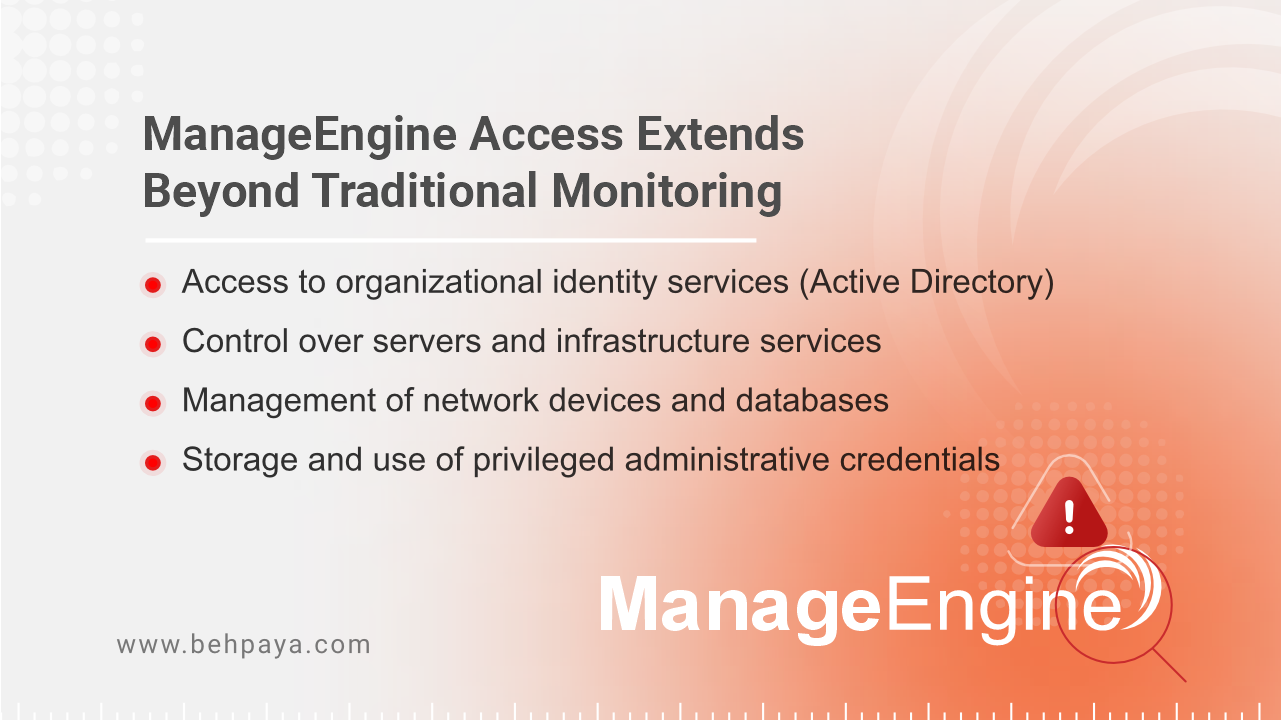
In many environments, ManageEngine is granted highly privileged accounts to perform tasks such as automated device discovery, service monitoring, script execution, and agent deployment. As a result, the server hosting the platform effectively becomes a centralized control point capable of directly interacting with a substantial portion of the organization’s infrastructure.
The significance of this becomes even greater when considering that many ManageEngine capabilities extend beyond passive monitoring and allow direct modifications within the environment — from executing commands on servers to changing network device configurations or deploying software at scale. Under such circumstances, if the platform is compromised, attackers may leverage the very same operational mechanisms originally designed for legitimate infrastructure management.
For this reason, infrastructure management platforms are often regarded as high-risk assets within modern security architecture. Once an attacker compromises this layer, there is little need to breach each server or device individually; the centralized platform itself can become a pivot point for movement across the network.
Credential Concentration: A High-Value Target for Attackers
Another frequently overlooked aspect of ManageEngine involves credential management and storage. To perform tasks such as service monitoring, remote command execution, system connectivity, and performance data collection, infrastructure management tools typically require access to a large number of usernames and passwords.
In many organizations, these credentials include privileged Windows accounts, Active Directory access, SSH credentials for Linux servers, database authentication details, and even login information for network devices. Consequently, the server hosting the management platform effectively becomes a repository of highly sensitive information.
The concentration of such extensive access within a single location naturally turns the platform into a highly valuable target for attackers. In a compromise scenario, an adversary may gain not only access to the management server itself, but also to credentials that provide access throughout the broader infrastructure.
This is one of the reasons advanced threat actors often prioritize compromising centralized management systems instead of targeting individual servers directly. Control over such a platform can translate into indirect access to a large portion of the enterprise environment.
When a Vulnerability Becomes Organization-Wide Access
The risks associated with these systems become even more serious when software vulnerabilities are taken into account. Over the past several years, multiple critical vulnerabilities have been disclosed in various ManageEngine modules, including flaws that enabled unauthenticated remote code execution (RCE).
In several high-profile incidents, advanced ransomware groups and sophisticated threat actors have exploited these vulnerabilities as initial access vectors for compromising entire networks and deploying ransomware. A successful breach of such a system can effectively provide attackers with administrative leverage across the enterprise environment.
In these scenarios, the issue extends far beyond the compromise of a single software server. Attackers gain access to a system that is already deeply integrated with multiple infrastructure components and operates with elevated privileges. In practical terms, compromising such a platform can provide indirect access to servers, services, and network devices across the organization.
In some cases, attackers have been observed abusing the platform’s own built-in administrative features for lateral movement inside the network. Capabilities originally intended for infrastructure automation — such as script execution, software deployment, and remote connectivity — can quickly become tools for expanding attacker access.
Why ManageEngine Risks Increase in Certain Environments
In practice, ManageEngine is not a single unified platform, but rather a collection of independent products, each responsible for different areas of infrastructure management — including network and server monitoring, Active Directory management, endpoint administration, log analysis, and password management. In many organizations, several of these products are deployed simultaneously and integrated together.
The result is a significant expansion of the attack surface, since each product introduces its own services, web interfaces, and authentication mechanisms. A vulnerability in any one of these components can potentially become an entry point into the broader infrastructure.
At the same time, many of these capabilities require extensive administrative privileges to operate correctly. Functions such as endpoint software deployment or modifying network device configurations often depend on the storage and use of highly privileged credentials. As a result, ManageEngine servers frequently become centralized hubs for administrative access throughout the infrastructure — making them highly effective platforms for lateral movement if compromised.
Conclusion
The traditional architecture of many infrastructure management platforms — built around broad administrative control and centralized operational authority — often conflicts with modern security paradigms such as Zero Trust Architecture.
What makes platforms like ManageEngine particularly sensitive is not merely the existence of software vulnerabilities, but the architectural role they occupy within enterprise infrastructure. These systems frequently operate with elevated privileges, maintain access to critical assets, and act as centralized control points across the environment. As a result, compromising such a platform can provide attackers with indirect access to large portions of an organization’s infrastructure.
In recent years, greater attention has been directed toward the security architecture of infrastructure management solutions. Modern approaches increasingly focus on reducing concentrated risk through granular access control, secure credential handling, comprehensive audit logging, stronger privilege separation, and adherence to the principle of least privilege.
Moein Monitoring Platform was developed with a stronger emphasis on security-focused architecture and minimizing dependency on centralized control points. In addition to implementing modern security practices, the platform has also received an official national cybersecurity certification, indicating that its software security controls, secure architecture, access management mechanisms, event logging processes, and vulnerability management practices have undergone formal security assessment.
Ultimately, selecting infrastructure management tools should not be based solely on operational capabilities or feature lists. Equally important is how well their architecture aligns with modern cybersecurity principles capable of protecting organizations against increasingly sophisticated threats.
Series of Articles on Dissecting ManageEngine




The Latest Articles
