
Dissecting SolarWinds (Part Three): Hidden Costs: The Realities of Licensing Models and Architecture

Before entering the discussion, it is necessary to emphasize that the goal of this series of articles is not to question the value or capability of the prominent IT infrastructure monitoring tools. Many of these solutions have been used in various organizations for years and play an important role in monitoring and managing IT environments. What is examined in this series of articles is more of an analytical look at some limitations and challenges that can become problematic for organizations. Therefore, if you intend to purchase SolarWinds software, we suggest that before making a decision, you also study the series of articles on dissecting SolarWinds.
When discussing the cost of software, attention is usually focused on license prices and support contracts. However, in many enterprise systems, a significant portion of the actual cost is hidden in areas that rarely appear in sales brochures: the architecture, the licensing model, and the underlying infrastructure required to run the software.
From a marketing perspective, SolarWinds is one of the most successful examples in the monitoring industry. With its diverse modules and relatively straightforward entry into organizations, the platform has proven highly effective at attracting new customers and expanding its footprint across enterprise IT environments. However, from the perspective of many technical and financial decision-makers, the true cost of the platform extends far beyond its initial licensing fee.
In this article, we examine some of SolarWinds' hidden costs—costs that are often overlooked during the purchasing process but can eventually represent a substantial portion of an organization's IT budget.
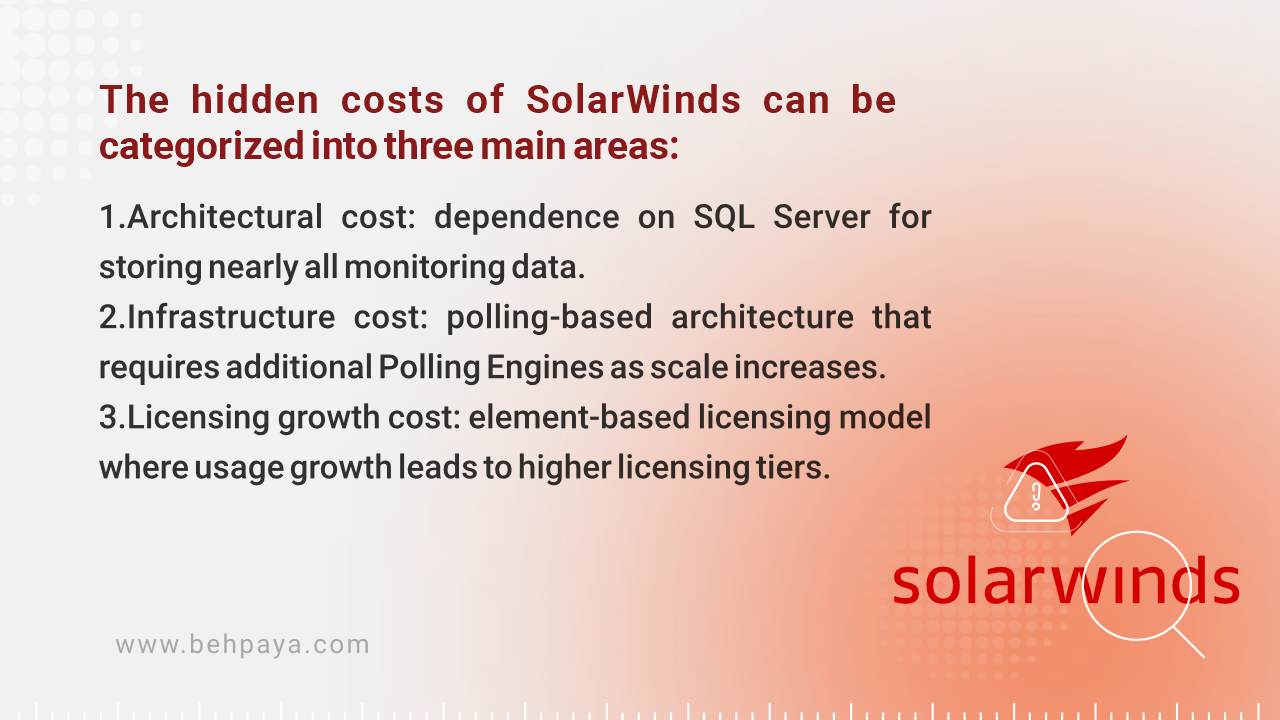
The Architectural Cost: Dependence on SQL Server
In the first article of our SolarWinds series, we discussed the platform's dependency on SQL Server and some of the technical challenges associated with that design. In this article, we examine the same issue from a different perspective: the financial impact that this dependency can create for organizations.
One of the most significant costs that is not immediately visible is SolarWinds' deep architectural dependence on Microsoft SQL Server. Within the Orion architecture, nearly all system data—including polling results, inventory information, alerts, and historical records—is stored in SQL Server.
In smaller environments, this dependency may not appear problematic. However, as the network grows and the number of monitored devices increases, the volume of data that must be stored and processed rises rapidly. Under these circumstances, organizations are often forced to invest in more powerful hardware resources, faster storage systems, and more capable editions of SQL Server simply to maintain acceptable performance.
To illustrate this more clearly, consider a simple scenario. Suppose an organization intends to monitor approximately 2,000 network devices and servers. At this scale, the volume of data collected through SolarWinds polling mechanisms grows rapidly, and the database becomes one of the most critical components of the monitoring infrastructure.
In many of these environments, SQL Server Standard may eventually become insufficient for the required processing and storage demands. Even attempting to sustain the environment on the Standard edition may require expensive database administrators and high-performance all-flash storage infrastructure. As a result, organizations are often compelled to migrate to SQL Server Enterprise.
The cost difference between these editions is significant. Under Microsoft's per-core licensing model, SQL Server Enterprise licensing is typically several times more expensive than the Standard edition.
In practical terms, an organization that initially deployed its monitoring infrastructure on SQL Server Standard may eventually find itself migrating to an edition whose licensing costs are several times higher than originally anticipated. These costs are rarely apparent during the initial SolarWinds purchase, but over time they can become a substantial component of the total cost of the monitoring platform.
Infrastructure Costs: Polling Architecture and the Growth of Monitoring Servers
Another cost that often receives less attention is related to SolarWinds' data collection model. At its architectural core, SolarWinds relies on a polling-based approach, meaning that monitoring servers periodically connect to devices, servers, and services to collect their operational status.
In smaller environments, this model generally functions without significant issues. However, as the number of monitored devices and services increases, the volume of polling requests also grows rapidly. Each polling operation involves establishing communication with a device, collecting data, and recording the results in the database. This process is continuously repeated across thousands of devices.
Under such conditions, a single monitoring server is eventually unable to manage all of these requests efficiently. Consequently, larger environments typically require the deployment of additional servers known as Additional Polling Engines in order to distribute the processing load.
At first glance, this appears to be a reasonable technical solution for increasing system capacity. In practice, however, it also translates directly into higher infrastructure costs.
Unlike many modern platforms that utilize lightweight collectors or relatively inexpensive agents, each new Polling Engine requires:
- A dedicated server
- Additional CPU and memory resources
- In many cases, additional software licenses
Furthermore, system complexity increases because each new server must be installed, configured, monitored, and maintained.
As a result, many large SolarWinds deployments gradually evolve into infrastructures composed of multiple servers, including:
- The Orion Core server
- A dedicated SQL Server
- Several Polling Engines
- In some cases, separate Web Console servers
- Additional High Availability components
Within such architectures, the real cost of the monitoring system extends far beyond the software itself and increasingly includes the infrastructure required to support it.
To better understand this issue, consider another simple scenario. Suppose an organization intends to monitor between 2,000 and 3,000 network devices and servers.
At this scale, organizations typically require:
- One Orion Core server
- One SQL Server
- At least one additional Polling Engine
As the environment grows—for example, through an increase in monitored devices or the number of collected metrics—additional Polling Engines often become necessary.
Every new Polling Engine means another server, additional database resources, and higher operational and maintenance costs.
In practice, adding only two additional Polling Engines can increase the cost of the monitoring infrastructure by approximately 30 to 60 percent compared to the original deployment.
The important point is that these costs are rarely obvious during the initial software purchase. However, as the environment grows and monitoring requirements expand, additional servers are gradually introduced into the architecture, causing the true cost of the platform to increase over time.
Licensing Growth Costs: The Element-Based Licensing Model
Another factor that can significantly increase the long-term cost of SolarWinds is its licensing model.
Although the company has introduced new pricing approaches in more recent offerings such as Hybrid Cloud Observability (HCO), the traditional Orion ecosystem—which remains widely deployed across many organizations—relies heavily on an element-based licensing model.
An Element may include:
- Nodes
- Interfaces
- Volumes
- Certain monitored metrics and resources
At first glance, this model appears straightforward and flexible because organizations can purchase licenses based on the number of resources they intend to monitor.
In practice, however, the number of Elements often grows much faster than the actual number of devices.
A single network device or server may contain multiple interfaces, storage volumes, or monitorable services, each of which is counted as a separate Element.
For example, suppose an organization intends to monitor 100 network switches.
If each switch contains an average of 48 active interfaces and those interfaces are monitored, the organization will consume approximately 4,800 Elements solely for interface monitoring.
If node status, volumes, and additional metrics are also monitored, the total Element count increases rapidly.
Because SolarWinds licensing is typically sold in predefined tiers, crossing a particular Element threshold can force an organization to upgrade to a higher licensing tier.
Under these circumstances, adding only a small number of devices or enabling a few additional metrics may trigger an upgrade to a substantially more expensive license.
To illustrate this, consider an organization that initially purchased licensing for approximately 5,000 Elements.
By adding a few additional switches, monitoring more interfaces, or enabling additional features, the organization may exceed that limit and be forced to upgrade to the next licensing tier—for example, 10,000 Elements—even if its actual usage remains significantly below that new capacity.
In practice, this often causes monitoring costs to increase gradually and sometimes unexpectedly.
Particularly in growing environments, the number of Elements can expand much faster than initially anticipated, creating additional licensing costs that were not part of the original budget.
For this reason, although the element-based licensing model may initially appear flexible, at larger scales it can become one of the most significant contributors to the Total Cost of Ownership (TCO) of the monitoring platform.
Conclusion: Moving Beyond Legacy Monitoring Architectures
The architectural patterns behind SQL Server–dependent monitoring platforms and element-based licensing models largely reflect the realities of an earlier generation of enterprise networks.
Organizations should not be forced to compensate for architectural scalability limitations by continuously purchasing more expensive hardware, larger databases, and additional licenses.
As modern infrastructures continue to grow in scale, complexity, and telemetry volume, the economics of monitoring become increasingly influenced by architecture itself rather than by software functionality alone.
For this reason, newer monitoring platforms have increasingly adopted alternative approaches, including distributed data processing, purpose-built time-series databases, and pricing models that align more closely with overall infrastructure scale rather than individual monitored elements.

Moein Monitoring Platform follows a similar architectural direction. By utilizing a purpose-built Time-Series Database (TSDB) architecture and a transparent licensing model based on broader infrastructure metrics rather than counting individual ports, interfaces, or monitored elements, the platform aims to reduce some of the operational and financial challenges commonly associated with traditional monitoring architectures.
Ultimately, selecting a monitoring platform should involve more than comparing feature lists or initial licensing costs. Equally important is understanding how the platform's architecture, scalability model, and long-term operational requirements align with the realities of modern enterprise infrastructure.
Series of Articles on Dissecting SolarWinds




The Latest Articles
